


Hu(e)man: Sound, Light and the Name Written in Us
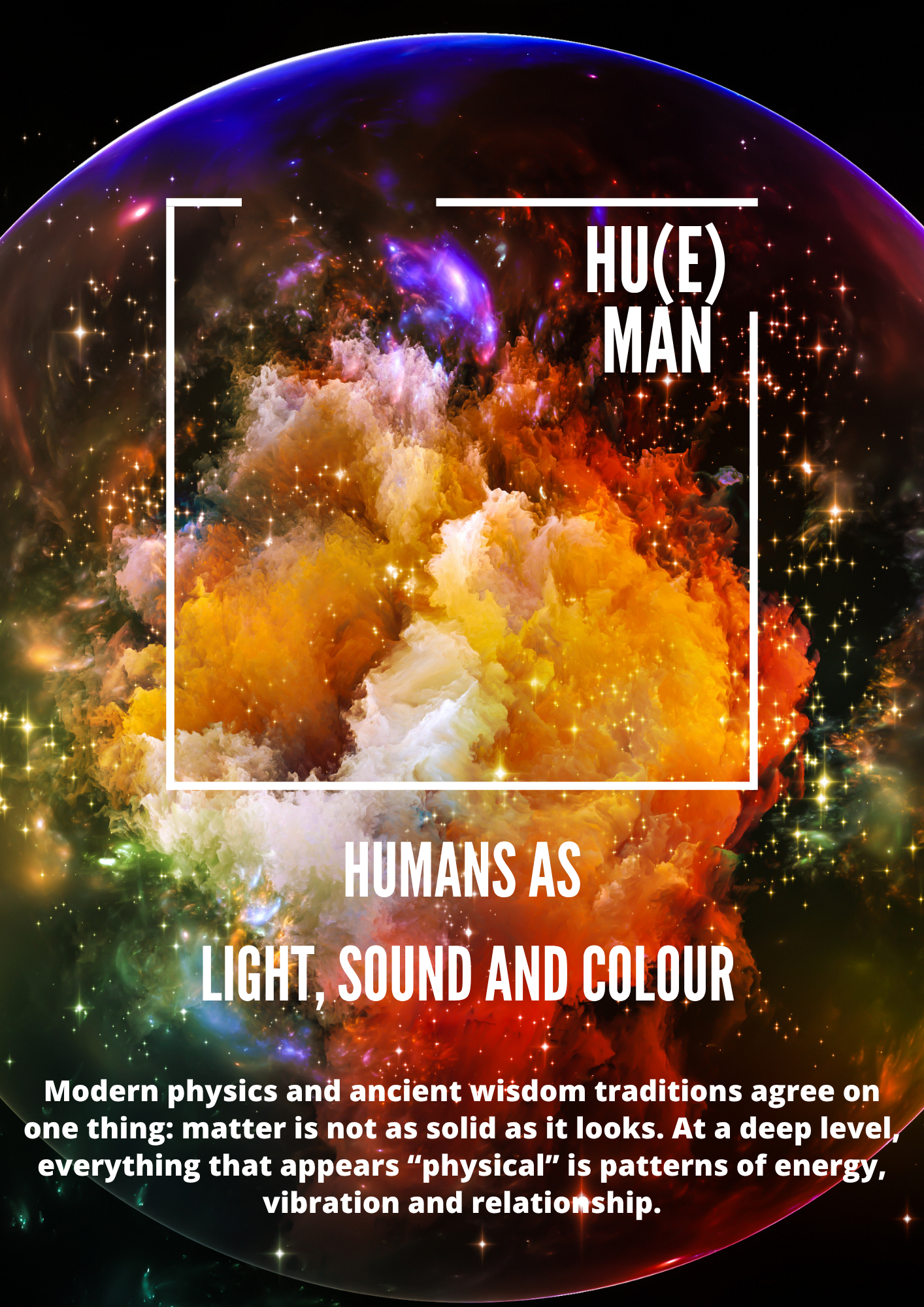
Hu(e)man began as a workshop, but really it is a meditation on what it means to be human when you remember that you are made of light, sound, colour, frequency and vibration.
It sits in that place where science brushes up against story, and where language stretches to hold things we mostly feel rather than prove.
The workshop asks participants to enter a space where breath, sound, colour, spirit and language are not separate things, but part of one living experience of being human.
A workshop rooted in voice, vibration, symbol, reflection and the possibility that language itself is a sacred bridge.
HU: the sound of being
In many spiritual traditions, HU (pronounced like “hue”) is understood as a sacred sound – a mantra, a name for God, and a way of calling the Divine into the centre of our awareness.
In Sufi practice, and in modern movements like Eckankar, HU is sometimes described as a universal sound of creation: a simple syllable that carries praise, remembrance and the soul’s longing for its Source.
In the Hu(e)man workshop, I use HU as a doorway – not into a single belief system, but into the felt experience that:
- we are vibrational beings
- sound is not just something we hear, but something we are
- the way we use our voices can bring us closer to or further from who we really are
Why this matters
Participants don’t have to “believe” in HU. They are invited to listen to what happens in their own bodies when they breathe it, whisper it, or simply sit in its echo.
The workshop is less about doctrine and more about encounter: what happens when sound becomes a way of listening inwardly, spiritually and physically all at once.
Humans as light, sound and colour
Modern physics and ancient wisdom traditions quietly agree on one thing: matter is not as solid as it looks. At a deep level, everything that appears “physical” is patterns of relationship, energy and movement.
When I say that humans are made of light, sound, colour, frequency and vibration, I’m not making a strict scientific claim – I’m pointing at something we can recognise in ourselves.
- Light: the ways we see and are seen, the radiance we carry when we are fully alive.
- Sound: our voice, our breath, our heartbeat, the songs and words that move through us.
- Colour: the moods, emotions and energetic tones that shape our presence in a room.
- Frequency: the tuning of our lives – what we resonate with, what we attract, what we amplify.
- Vibration: the subtle movements in our nervous system, the quiet yes and no that arrive before language.
Is the Name of God written in our DNA?
Around this theme, there is a popular spiritual idea that the Name of God is literally written into human DNA – especially the Hebrew four-letter Name YHWH (Yod–Heh–Vav–Heh).
Different versions of this idea have been shared in books, videos and social media. Most of them work symbolically rather than scientifically, but they reveal something important: our deep desire to know that we are not random.
People often talk about two main strands: the 10–5–6–5 pattern, and Gregg Braden’s “God Code”.
If my very being is a kind of prayer, how do I want to live?
1. The 10–5–6–5 pattern
In Hebrew, letters have numerical values (a practice called gematria). The Name YHWH is often mapped as:
- Yod (י) = 10
- Heh (ה) = 5
- Vav (ו) = 6
- Heh (ה) = 5
Some versions of the “God in the DNA” idea claim that certain repeating structural patterns in DNA follow a 10–5–6–5 rhythm, and therefore encode the divine Name.
For me, it functions more as a poetic way of saying: Every strand of us whispers a sacred pattern.
2. Gregg Braden’s “God Code”
Another version comes from Gregg Braden’s book The God Code. He approaches the question differently, by looking at the elements that make up human life.
- He takes key elements in the body such as hydrogen, nitrogen, oxygen and carbon.
- He assigns Hebrew letters to them based on atomic values.
- He suggests that the translated pattern forms Y–H–W–H.
Mainstream science does not use this method or draw these conclusions, but as a spiritual metaphor it invites us to see our own bodies as sacred texts rather than as accidents.
How Hu(e)man holds these ideas
In Hu(e)man, I don’t ask anyone to accept these theories as literal fact. Instead, I invite participants to sit inside the questions and notice what moves in them.
We explore how it feels to:
- treat HU as a living sound
- imagine that DNA is speaking a holy Name, whether or not the science agrees
- see themselves as carriers of light, colour, frequency and sacred sound
Living inside the question
What matters here is not proving a theory beyond all doubt, but allowing symbol, sound and language to open a deeper quality of attention.
Hu(e)man invites a reflective encounter with voice, breath, resonance and meaning. It offers a space where participants can meet themselves not as fixed objects, but as living presences shaped by vibration, memory and relation.
Where Hu(e)man meets Medu Neter and Sekhmet’s Sanctuary
Hu(e)man explores human beings as made of light, sound, colour, frequency and vibration. It sits alongside two sister strands: the Medu Neter enquiry into sacred language, and Sekhmet’s Sanctuary, a travelling Kemetic-rooted space of rest, reading and creative wellbeing.
Together, these three pathways form a circle. Medu Neter considers the meaning and ancestry of words; Hu(e)man listens for their tone, resonance and energetic colour; Sekhmet’s Sanctuary offers the physical place where these currents can be experienced in community, body and breath.
The Medu Neter and the living power of words
Visit the Medu Neter page to explore how “Divine Words” frames language as something alive and formative, tracing lines between Kemetic symbolism, later alphabets and the way we speak and write today.
Sekhmet’s Sanctuary in community
Visit Sekhmet’s Sanctuary to see how these ideas take shape in a travelling sanctuary space – appearing in festivals, libraries and community venues – where poetry, reading, Hu(e)man practice and Kemetic holistic health meet.
For some people, this becomes a doorway into awe and self-respect. For others, it offers a creative and healing way to reconnect with body, voice, faith and belonging.
Hu(e)man is not about winning an argument between science and spirituality. It is about standing in the mystery of being human and letting the question itself transform us: What if, in every hue and every heartbeat, we are already sounding the Name?