


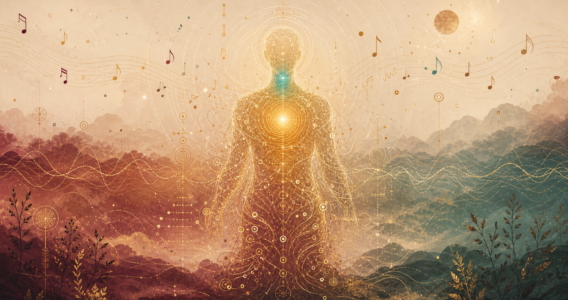
Word Mechanics & Light Language: When Speech Becomes Geometry
This reflection begins with a question cymatics leaves quietly waiting for us: if a pure tone can draw geometry in water, what are our sentences drawing all the time?
It sits close to the spirit of this work, where sound, symbol, breath, memory and meaning are not separate themes, but part of one enquiry into what language does in a human life.
Word mechanics begins there, in the recognition that speech is not only semantic. It is tonal, rhythmic, embodied and formative.

A reflection rooted in language, frequency, symbol, memory and the possibility that words become structures long before we consciously examine them.
When speech becomes vibration
We already know this in ordinary life. We say that words sting, soothe, land, echo, wound or open us. We describe certain voices as heavy, warm, cutting, calm or bright.
These phrases are more than metaphor. They point towards an older understanding that language moves through the body as an event, not merely as information.
Repeated phrases can begin to function like programmes the nervous system keeps trying to run. A blessing can steady a person. A shaming sentence can fracture something for years.
Why this matters
The words we live with become emotional architectures.
They build internal rooms of fear, permission, memory, tenderness or restraint, and they shape the atmosphere we carry into relationship.
Glyphs and geometry
Light language is often described as communication that reaches the body before the intellect. It may appear as tone, chant, humming, glyph, writing, symbol or movement.
In that frame, glyphs can be understood as encoded images: visual forms holding more than one layer of meaning at once. Many seem to arise through circles, triangles, stars, spirals and intersecting lines. Sacred geometry becomes a kind of visual grammar for what resists ordinary translation.
Geometry as visual grammar

Every phrase is a geometry in motion, whether we speak it with care or by habit.
The stages of creation and spoken pattern
The creation sequence offers a companion image for language as well. The first circle suggests unity before division. The Vesica Piscis introduces relation and opening. The Seed and Egg of Life show repetition becoming living structure. The Flower of Life expands into a field of interconnection. The Fruit of Life and Metatron’s Cube imply deeper codes within the visible whole.
Word mechanics can be read in much the same way: one sound, then relation, then repetition, then a wider matrix of meaning built over time.
Pattern becoming language


Language as living pattern
If words are vibrational events, then language is never neutral. Every poem, prayer, affirmation, argument, whisper and chant leaves some kind of pattern behind.
That does not mean every sentence must be perfect. It means attention matters. Tone matters. Repetition matters. The language we practise becomes part of the world we inhabit.
Patterns in memory and form

Where word mechanics meets sound and embodiment
This reflection brings the earlier strands together. Cymatics asks how sound becomes visible. Frequency work asks how vibration is felt in the body. Word mechanics asks what happens when those currents become speech, prayer, naming, memory and relation.
Taken together, they invite a more careful intimacy with language itself: not only what words mean, but what they do.
Cymatics: When Sound Draws Sacred Geometry
Return to the visual threshold where tone becomes pattern and sacred geometry emerges from vibration.
Frequencies & the Human Instrument
Revisit the body’s relationship with resonance, coherence, nervous-system tuning and embodied listening.
Reflection question: Which phrases in your life have become inner architecture, and what might change if you rewrote even one of them with greater care?
For some people, this becomes a writing practice. For others, it becomes a healing practice, or simply a new way of hearing what has always been present.
Word mechanics is not about policing language into perfection. It is about recognising that speech is alive, and asking what kind of world our repeated words are helping to build.