


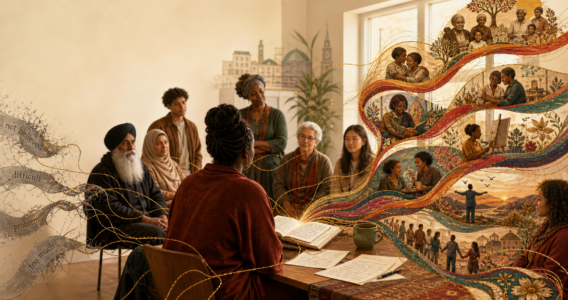
Narrative Justice: More Than a Single Story
So, today, I am focusing on narrative justice and the stories people are permitted to tell about themselves — and the stories that are too often imposed upon them. In a town of many languages, migrations, faiths and cultural histories, representation can still be uneven, selective and shaped by power.
Narrative justice means making room for people to define their own experiences, to be heard in context and to have their lives understood as more than a single story.
I work with women and men affected by domestic and sexual abuse, across different ethnic, religious, cultural and class backgrounds. This work continually reminds me that abuse is never experienced in isolation from the social world around a person.
Race, gender, class, migration status, faith, culture, disability and other aspects of identity can shape how abuse is understood within a family or community — and how someone is treated when they seek safety, report harm or ask for support.
When harm meets the social world
The effects of abuse can be compounded when systems do not believe people, minimise their experiences, stereotype them or expect excessive proof before support is offered. The experience of asking for help can become another site of harm.
Different people may face different barriers. Who is assumed to be credible? Who is labelled “difficult”? Who is considered deserving of protection? Whose culture is misunderstood? Whose pain is treated as ordinary, expected or unimportant?
These are not simply cultural differences. They are questions of power, and of how institutions respond differently according to race, gender, class, migration status, disability, faith and other social positions.
Being believed should not be a privilege
For many survivors, the demand to prove racism, sexism, abuse, harassment or exclusion comes before care is offered. The person may be asked to recount, evidence, explain and justify their pain repeatedly before it is recognised.
But the burden of proof can become an additional trauma. It can leave people feeling that their own memory, language, culture or emotional response is being placed on trial.
To listen well is not to abandon professional curiosity. It is to make sure curiosity does not become another form of disbelief.
Narrative Justice: The danger of a single story
Chimamanda Ngozi Adichie’s idea of the danger of a single story resonates strongly here. Labels such as “Black”, “Caribbean” or “African” are often treated as though each names one culture or one experience.
In reality, there are many islands, nations, languages, histories, faiths, class experiences and family stories. When people assume they already know who someone is, they can stop being curious about the whole person.
Dominant stories can flatten identity. They can obscure both the specificity of a person’s culture and the reality of what they have lived through.
Lives are multi-storied
The narrative metaphor demonstrates how lives are often reduced to a single description: survivor, migrant, victim, difficult, poor, Black, outsider, problem. A single description may hold part of a truth, but it can never hold the whole person.
For Black women, Caribbean people, migrants, survivors of abuse and others who have been marginalised, dominant narratives can become especially restrictive. They can shape how a person is seen before they have had the chance to speak.
A multi-storied view creates room for complexity. It asks us to listen beyond the problem-saturated account and to remain interested in the richness, contradiction, history and agency of a person’s life.
“The person is not the problem; the problem is the problem.”
Michael White – Article 4 (draft) Charter of Storytelling RightsStorytelling rights and Narrative justice
What stands out to me in the draft Charter of Storytelling Rights is the assertion that people have the right to define their experiences in their own terms, to have their lives understood in context, and to have their responses to trauma recognised.
This matters because the effects of injustice are often located inside the person — as though they are deficient, difficult or somehow the problem — instead of being understood in relation to what has happened to them and the systems around them.
In my community, this is not an abstract point. It is clearly demonstrated in the ways people can be interpreted, dismissed or expected to carry the consequences of injustice alone.
Listening for overlooked knowledge
Thinking of lives as multi-storied invites another kind of listening. It invites us to notice what may have been overlooked, minimised or made invisible.
- Survival skills and acts of resistance
- Cultural knowledge, language and memory
- Acts of care and the relationships that sustain people
- Creativity, values, hopes and contributions
- The choices people have made, even in constrained circumstances
These stories do not erase harm. They stop harm from becoming the sole definition of a person’s identity.
Collective witnessing
There is also something important about collective witnessing: being believed by others, knowing that we are not alone, and finding language for experiences that have too often been dismissed.
Witnessing does not mean speaking for somebody else or deciding what their story should mean. It means making a respectful place where people can be heard in context, without having to reduce themselves to a version that others find easier to accept.
In this way, listening can become a practice of solidarity rather than simply a method of gathering information.
Poetry, language and fuller stories
This is one reason narrative approaches, listening spaces and creative practices such as poetry matter to me — and why I use them in my practice.
Poetry can hold what ordinary language sometimes cannot. It can make room for silence, contradiction, image, rhythm, grief, anger, memory and hope without demanding that a life be explained in a neat or linear way.
Creative practice can help people tell fuller stories: stories that do not deny harm, but do not allow harm to become the whole definition of who they are.
Making room for the whole person
Narrative justice asks us to look beyond who is visible and consider whose stories are heard, whose knowledge is recognised and whose experience is treated as meaningful.
To resist a single story is to remain curious. It is to refuse easy assumptions about culture, race, gender, faith, class or survival. It is to understand that a person may carry pain and also wisdom; trauma and also creativity; exclusion and also deep belonging.
For me, the task is to keep creating spaces where people do not have to prove their humanity before they are listened to — and where their lives can be understood as the rich, complex, multi-storied realities they are.
Hu(e)man: Colour, Sound and Embodiment
Explore language, identity, colour and embodiment as interconnected ways of making meaning.
Cymatics: When Sound Draws Sacred Geometry
Return to the enquiry of pattern, form and the ways unseen forces can become visible.
Reflection question: What is a story about you, your community or your culture that feels too small — and what other stories deserve to be heard alongside it?