

Our House: Who Killed Eve? at Bedfordshire Police HQ
This week, our hand-built 3D advent calendar house rolled into Bedfordshire Police Headquarters and took up residence in front of the RASSO team.
Twenty-five doors. Twenty-five fragments of story. One question that refuses to sit still: Who killed Eve?
In that courtroom-like space, the house became more than an object. It became a threshold into headlines, police logs, whispered gossip, courtroom language and the inherited stories that shape how victims are seen, heard and judged.
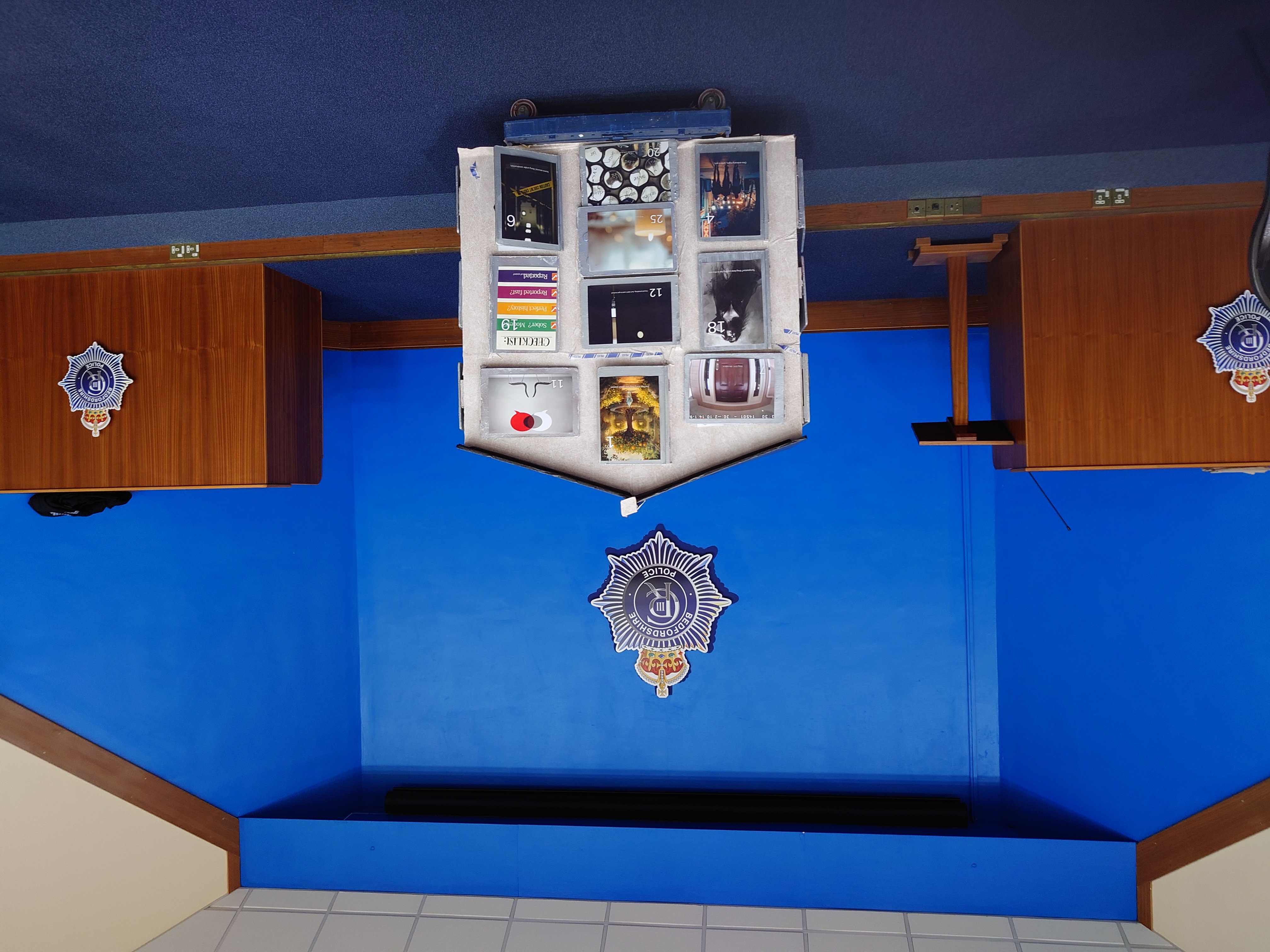
Our House: Who Killed Eve? installed at Bedfordshire Police Headquarters for a workshop with the RASSO team.
Twenty-five doors into a culture
Across the Our House: Who Killed Eve? workshop, officers and staff stepped up to the house and opened doors marked with headlines, crime scene tape, text messages, courtroom scripts and whispered gossip. Behind each door sat a short audio clip, a visual clue and a small but revealing choice about what participants noticed, believed or quietly dismissed.
The house asks people to slow down and pay attention to the stories surrounding violence. Not just the obvious story of the crime itself, but the subtler stories that move underneath it: who sounds credible, who gets doubted, whose behaviour becomes the focus, and how quickly a victim can find herself under scrutiny.
More than a murder mystery
Our House: Who Killed Eve? uses immersive installation, poetry, sound and guided reflection to expose the cultural roots of rape myths, victim-blaming and institutional gaslighting.
The point is not to shock for the sake of it. It is to create a carefully held, trauma-informed space where participants can examine how language, systems and long-standing narratives about “dangerous women” continue to shape practice today.
What “killed” Eve in this house — a person, a culture or a story?
The questions after the doors
In the Room of Truth afterwards, we invited participants to sit with a set of difficult but necessary questions:
- What “killed” Eve in this house – a person, a culture or a story?
- Where did victim-blaming and institutional gaslighting show up in the material – and in the mirrors it held up to real practice?
- What one concrete change could each person make in their questioning, recording or responding to survivors?
These are not abstract questions. They ask people to look carefully at the distance between policy and practice, between intention and impact, between procedure and what it feels like to live through it.

Our House: Who Killed Eve? installation in situ at Bedfordshire Police Headquarters, holding space for reflection, dialogue and practice change.

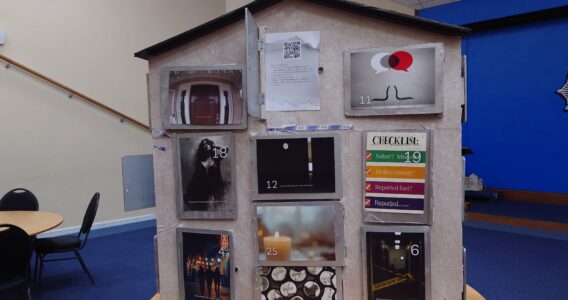
Our House: Who Killed Eve? A closer view of the front of the house, where each numbered door opens onto an audio, image or fragment of narrative.
Where evidence meets myth
It is hard work inviting people whose daily job is evidence, investigation and procedure to sit inside a myth, a murder mystery and a set of uncomfortable truths about rape culture.
And yet this is where some of the most powerful conversations can happen: not around who is a “good” or “bad” professional, but around inherited scripts, repeated assumptions and institutional habits that can quietly distort what justice looks like.
The workshop does not ask participants to abandon professional rigour. It asks what happens when rigour is shaped by deeper awareness, sharper listening and a more critical understanding of the cultural stories that surround victimhood and blame.
The house in the room
Seeing the house at Bedfordshire Police HQ carried its own kind of resonance. A handmade structure, built around doors and fragments, placed within an institutional setting associated with authority, judgement and evidence.
That contrast matters. The installation does not arrive as a lecture. It arrives as an invitation: open a door, hear a voice, notice your assumptions, follow the trail, ask what shaped your response.

Our House: Who Killed Eve? A side view of the house reveals more of the layered imagery and prompts carried across its 25 doors.

Our House: Who Killed Eve? The front of the house holds fragments of story, accusation, silence, ritual and reflection.
The workshop space at HQ created a striking backdrop for conversations about justice, harm and cultural change.
Bring Our House to your organisation
Huge gratitude to Bedfordshire Police for hosting the installation at HQ and to the RASSO team for engaging so deeply and honestly with a challenging, trauma-informed space.
If your organisation would like to host Our House: Who Killed Eve? – whether for staff teams, partners, tenants, community groups or faith groups – you can find full workshop details, learning outcomes and booking information below.
Our House: Who Killed Eve? – A Murder Mystery Adventure
Explore the full workshop outline, learning outcomes, safeguarding approach and ways to book a visit for your team or organisation.
Why this work exists
Our House brings together creative practice, trauma-informed facilitation, poetry, sound and visual storytelling to help organisations reflect more deeply on harm, justice and survivor experience.
Sometimes culture change begins with policy. Sometimes it begins with training. And sometimes it begins with a small door opening in a handmade house, and a room full of people realising that the story they thought they knew needs to be read differently.